
Inspiration-Letters - Saints edition
Inspiration-Letters - Saints edition pdf - in pdf format.
Joy through renunciation - the life and times of Francis of Assisi
by Abhinabha Tangerman
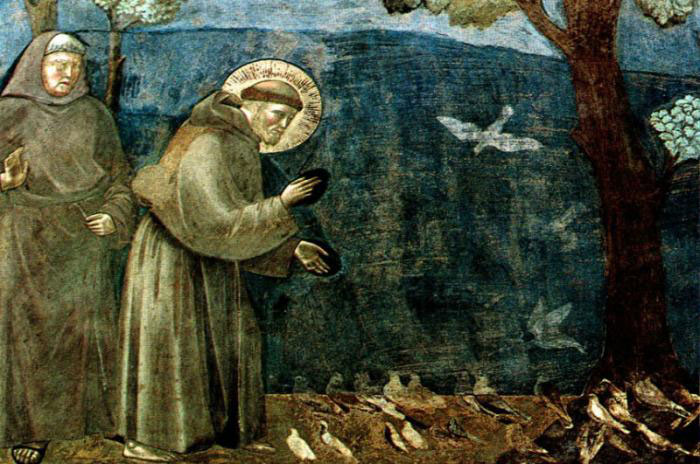
Once a beggar woman knocked on the door of the small church where Saint Francis of Assisi was praying together with his monk brothers. She humbly asked for alms, but the only possession the monks had was an old bible. “Give her that!” Saint Francis exclaimed. “I am sure our Lord will be more pleased by that than if we read it ourselves.”
Saint Francis knew that there is more joy in giving than in taking. He also knew that if you possess nothing, you have nothing to lose. “Lady Poverty exposes the greed and worries of the world,” he once said.
Sweetness in soul and body
Although Francis of Assisi (1182-1226) is perhaps the best known saint in the Christian world, his early life showed little signs of sainthood. Francis was born the son of a rich Italian textile merchant and grew up with a silver spoon in his mouth. He loved wine, parties and women and indulged his privileged life lavishly.
His transformation occurred when he rode by a leper one day. Something made him stop, descend from his horse and approach the sufferer. A strong inner feeling compelled him to grab the leper’s festering hand and kiss it. Instead of revulsion Francis felt a deep bliss. “What seemed bitter to me at first turned into sweetness in soul and body,” he later commented.
A few days later he collected a large sum of money, rode to a leprosy settlement and distributed the wealth among all the lepers, kissing their hands as they received it. He felt such joy in his selfless act that he decided to renounce his life of wealth and luxury and to devote himself entirely to a life of divine compassion, simplicity and poverty.
The last hurdle to his spiritual life was his father, who stood vehemently against his son’s decision. Furious, he sued his son for stealing his money and giving it away to the lepers. The local bishop summoned Francis to return the money to his father. Without missing a beat Francis took off his expensive clothes, put his purse on top and placed the bundle at the feet of his father, saying, “Up until now I have always called you my father, but from now on I only recognise our heavenly Father.” His father left in a huff, but the bishop was deeply impressed with Francis’ courage and sacrifice.
A thin rag for bedding
With great zeal Francis moved into his new life as a wandering monk and renunciate. His devotion to Lady Poverty was absolute. Anyone that wanted to follow him had to sell all his possessions, give them away to the poor and vow to never possess anything else during his entire life. That also included book knowledge. Francis felt that worldly knowledge led seekers away from the true wisdom that prayer provided.
He called his order the frater minores or ‘little brothers’. Because a house was also deemed a possession the little brothers slept in an old barn with nothing but a thin rag for bedding, even in winter. When a farmer came to claim the barn the brothers left immediately.
Preaching, singing and begging Francis and his little brothers wandered from town to town through the North Italian countryside. With their torn clothes, ragged appearance and bare feet they looked like beggars and were often mocked and ridiculed. Instead of losing heart, the mockery strengthened Francis’ resolve. When once asked what true joy was to him he replied, “If I would be returning from Perugia on a dark winter night through the mud and my legs would bleed from the icicles at the edges of my habit, and if I would knock twice at the door of our church and would be sent away twice, and if I would knock for the third time and would be told to go to another monastery, I tell you that if I kept patience and was not upset—that is true joy and true virtue and salvation of the soul.”
A new kind of fool
Despite his unorthodox behaviour Saint Francis became immensely popular. He was blessed with acting talent and also possessed great charisma and a keen sense of humour with which he turned his public sermons into lively theatrical performances. Combined with his inner wisdom acquired through endless hours of prayer and the joy that visibly radiated from his face he attracted large crowds everywhere he went.
As one of the first saints Francis also accepted women to have an order in his name. The first woman among his followers was the 17-year-old Clara of Favarone, who later founded the Order of Poor Ladies.
Yet Francis’ popularity also posed challenges. Among his growing order of followers his ideals of simplicity and poverty proved increasingly difficult to maintain. Some of his new and influential followers as well as the Catholic church, to which Francis was deeply devoted, thought his ideas were too extreme. But Francis didn’t budge. At one occasion he discovered several little brothers building a house. Furious at their disobedience he climbed the roof and started dislodging the roofing tiles and throwing them down. Another time when a high ranking cardinal tried to persuade him to tone down his renunciation, he took the man by the hand, led him to the centre of the congregation and spoke to the assembled crowd, “My brothers! God has called me to go the path of simplicity and I do not want you to continue forcing another rule unto me. The Lord has told me he wanted me to be a new kind of fool and He does not want us to be guided by any higher form of wisdom.” With his characteristic zeal he added, “God will punish you for your knowledge and I trust His accomplices will make you pay dearly.” The cardinal was stupefied.
Although Saint Francis was undoubtedly aware of the hypocrisy of priests and cardinals who valued wealth, power and prestige above Christian values, he refused to judge their imperfections and instructed his brothers to always respect the cloth, no matter how uncouth their behaviour might be.
Brother fire, lower your heat!
To Francis obedience to the divine Will was the highest virtue. During his prayers and meditations he sometimes heard the voice of God. But He also experienced the divine guidance in the ordinary events of daily life. Each incidence to him was full of meaning. When questions or issues pressed him, he used to open up the bible to a random page and take the text he read there as his answer.
Francis liked to lead by example. Once when he was invited to a sumptuous dinner at the palace of a cardinal friend, he went round to all dignitaries seated at the table and offered them the breadcrumbs he had received for alms that very day. “I have to represent your poor brothers,” he later explained his unusual behaviour to his cardinal friend, “because I know some of them are too proud to lower themselves to go begging or perform other services. I get more satisfaction from sharing this meagre food than by sitting at your abundant table, for the bread of charity is sacred.”
To Francis the entire creation was blessed with the divine spark. He could discern that spark in all creatures, endowing him with filial love for all. Even animals he considered his true brothers and sisters. To a braying donkey that disturbed his sermon he said, “Brother donkey, please be quiet and let me continue preaching.” As legend would have it, the donkey fell silent. His best known interaction with animals is his sermon to the birds, where Francis instructs a group of birds whom he called his ‘dear little sisters’ to always praise God with their song.
The elements were also part of Francis’ divine extended family. He sometimes communicated with them as well. At one time Francis had to undergo serious eye surgery, which in those days involved putting burning hot irons to his temples. Before the operation he prayed, “My brother fire, please be kind to me in this hour, since I have always loved you and will continue loving you. I beg our Creator that made you to lower your heat so that I will be able to bear it.” Indeed, after the operation Francis said that he had felt heat nor pain.
Receiving the stigmata
Despite his joy, zeal and cheerfulness Francis’ life also had its tragedies. At the end of his life he suffered from crushing tuberculosis and malaria, which caused occasional depressions. An eye infection had made him practically blind. Even more painful to him was the fact that he was unable to maintain his strict rules of renunciation and poverty among the members of his own order. The Catholic church had forced him to appoint priests, erect centers of study and live inside monasteries.
Yet the joy of his prayer life ultimately overpowered his physical and political challenges. Just two years before his death he was blessed with an unparallelled spiritual experience. One morning in the year 1224 Francis received a vision of Jesus as a crucified angel, giving him a feeling of ineffable ecstasy. After the experience faded Francis’ he was indelibly marked with the stigmata, the crucifixion wounds of Jesus. His hands and feet seemed like they were pierced with nails and a bleeding wound also appeared in his side. It was a confirmation of Francis’ inseparable oneness with the suffering of his Master. In later centuries more saints were blessed with the stigmata, but Francis was the first of his kind.
Francis died knowing that only very few were able to follow him in his radical renunciation, but also in the reassurance that his order would spread the virtues of simplicity and lack of possessions all over the world.
St Sylvester
by Dhiraja McBryde
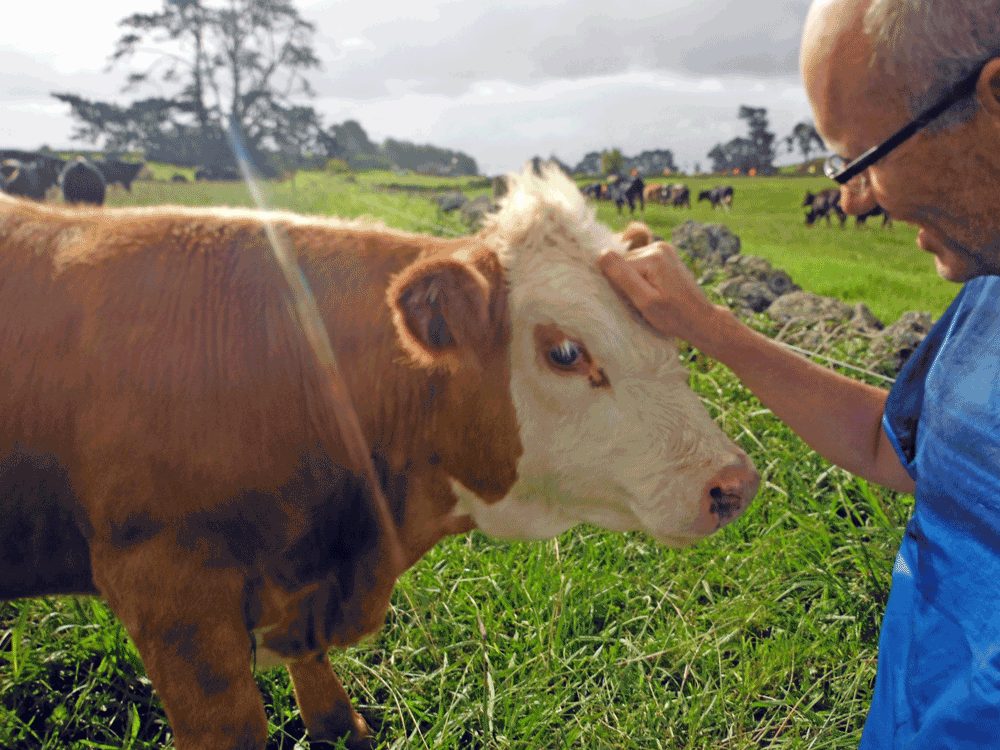 I like cows. Few things give me more satisfaction that to walk or run through the green New Zealand countryside and stop and chat to its placid bovine inhabitants. Sometimes they will gather around and gaze at the strange monkey-man who actually gives them the time of day. They listen as I sing them a song. Some will lick my hand, nuzzle with their big wet noses. Some cows like to have their foreheads itched, their flanks stroked. Sometimes a herd will run with me across the paddocks – each beast a tonne on nimble (we hope) hoofs. Some individuals are particularly affectionate and will always come over for a chat when they spot me.
All this, of course, cuts into any rigorous marathon training but it is worthwhile.
So when I saw the painting I was intrigued. It was called ‘The Miracle of St Sylvester’ and had been painted in the 1450s by one Francesco di Stefano, known as Pesellino, a contemporary of Fra Filippo Lippi.
You can imagine the stage-like setting – a loggia with the requisite perspective lines to let the viewer know that we have left the gothic and are firmly in the new scientific world of the renaissance.
And, right in the middle of the long composition – a cow!
What else do we notice? At one end of the painting sits a woman with a crown; let us call her the queen. At the other end, a man with a funny hat sits on what can only be a throne; let us call him the king though his hat does make him look a little like Robin Hood.
There are, walking about or sitting around, various renaissance-looking folk in drapery or in tights and with Beatles mop-top haircuts but the focal point of all this painting is definitely the cow.
Is it dancing? Is it bowing? Is it standing up or getting down? Certainly its front end is lowered – one knee on the terracotta tiles of the loggia, its other front leg bent.
And kneeling in front of the cow – a man in a different sort of funny hat, a hat that I recognise as denoting him as the pope, though Pope Paul VI was the last pope to wear this particular sort of hat and that was in 1963, before I was born.
To us it is a mysterious painting, but folks in 1450 knew their saints. Seeing the painting in Florence fresh from the studio they did not need it decoded – they knew the stories.
The ‘king’ is of course the emperor Constantine, the ‘queen’ is his mum, St Helena, and the kneeling man, his papal tiara surrounded by a saintly halo, can only be Pope St Sylvester I.
The story is of how the magician – that would be the man with the red, squashy hat – demonstrated his power by whispering in the ear of ‘a cruel bull’ certain unknown phrases upon which the poor bovine fell down dead, just so much inert beef where once was such life. However, St Sylvester ‘made his orisons and prayers to our Lord and said to the bull, “I command thee bull, arise thou up and go thou with the other beasts debonairly,” and anon the bull arose and went forth softly’. This we learn from ‘The Life of St Sylvester’ written by Jacobus de Voragine in 1260.
The outcome of this story is that … the emperor’s mum, much impressed, became a Christian – and, of course, went on to become St Helena.
Sylvester was indeed pope from 314 to 335. Did he bring a dead bull back to life as they wrote of him 900 years later?
Let us reserve judgement until we read further in ‘The Life of St Sylvester’.
The next story is that there was a dragon that lived in a pit in Rome and it burnt up 300 men every day with its fiery breath and St Sylvester sewed its mouth shut and thus saved the city.
Now, I have read enough of the writings of Sir Laurens van der Post to know that this is the kind of imagery that Jung and such-like folks very happily and easily interpret in terms of symbols and states of being and psychology and archetypes and that only hillbillies need take them as accounts of actual historical events.
And that is the beauty of the saints – they are stories. Did St Hubert really pursue a white stag; was St Kenneth, as a child, really raised by seagulls; did St James float to Spain in a stone boat … ?
All families have stories, stories of past events, stories that cement shared experiences, the bonds of affection and belonging and oneness between family members – one great grandfather going ‘a nutting’ as a child in England; the other, walking miles each day to labour in the lime quarry; the lizard that fell out of the thatch into the porridge; grandfather being excommunicated … The stories are told around the table, around the fire, around the family.
And so with all groups, each spiritual path. Beyond the great stories of what the Masters and the great prophets said and did are the little stories of individuals responding to and living the ideals of the group.
These stories remind us that we are never alone. We walk the road not alone but accompanied by all the other people who have walked it before – those ‘gone before us marked with the sign of faith’.
A Buddhist writer I read put it thus – that when we sit to meditate, we should imagine a crowd, a host, of other individuals gathered with us – great spiritual luminaries, humble holy folk from the past, our ancestors in the physical world, or ancestors in the spiritual world, all delighted that we are sitting down to meditate. Supportive and encouraging, they smile on us.
It is what the Christians call ‘the body of Christ’ – all the people, living and dead, moving in the same direction with common purpose, forming one unified entity.
And the lives of the saints are the stories of this multitude. They are the stories that we tell around the campfire in the dark of a world that is often inimical to the ideals of those saints. In the light of the dancing flames we are uplifted by tales of bravery and faith and compassion and love – St Teresa of Calcutta tending the dying, St Francis casting aside all his privilege for a life of holy poverty, St Oscar Romero laying down his life for the oppressed.
And from the stories we draw inspiration and, from that, aspiration arises that we might carry on ourselves.
And so varied is the panoply of saints that there is something to appeal to everyone, everywhere at any time.
When I was 17 I took the name Anthony after the Egyptian saint from the third century of that name – hermit, mystic, father of monasticism.
When I was 30 I stood agog in a church in Budapest before a statue of St Margaret who lived on the Island of Rabbits in the blue river.
Recently it was pointed out to me that there are no words of St Joseph recorded – he is the saint of silence.
All the saints, all the stories, help us along.
And next time I meet a bull, as sometimes I do on my runs across the fields, a bull all debonair and soft, I will relate to him the story of St Sylvester.
An unknowing saint
by Mahiruha Klein
 I'll never forget the first time I meditated, I really meditated. I was in my second semester of Freshman year at College, it was the first day of class, and I was waiting for the Philosophy Professor to come in, Dominick I. I didn't expect to be awed or impressed by him. After all, I had read a lot of philosophy in high school, had been on the debate team, and "knew my stuff". I thought, on the contrary, I would impress him with my wide reading and acumen!
Then he walks in, and he was a short, Italian man, with his hair combed back, elderly, liver spots on his hands, immaculately groomed, and something else-
I don't know another way to describe this, but the entire room was flooded with light when he entered. I mean, everything started breathing - the desks, the walls, the chalkboard. I could just smile and smile as I felt my body becoming lighter and lighter.
He spoke so calmly, so clearly, yet behind the words he spoke I felt an infinite calm, an infinite poise and peace, a true solid mass of joy that was his inner self.
This man was very influential in my life because as soon as I saw him, I said to myself, "I want that. I want that peace, I want that poise, I want that joy."
To the very day I die I will treasure this experience. This man prepared me to meet Guru.
It's funny, I once came to his office and told him that I see and feel light in him and he seemed so surprised! I told an older disciple that I was shocked at his surprise, that he didn't seem to know that he offered such light. My friend said that is the sign of humility. If he was preoccupied with the fact that he brought this divinity into the classroom, then that would have been the wrong attitude. Humility is a sign of real spiritual greatness. It's also one of the hardest divine qualities to get- right up there with unconditional surrender and detachment. Sri Aurobindo writes, "Therefore we know by that humility that Thou art God."
I guess because I have such a high Guru, a great God-realised soul, that my more instinctive reaction is "so what" towards saints and seers. How stupid of me! I still live in the world of name and form and relativity.
Yes, I am lucky and privileged to have a Guru who is an Avatar. I am also lucky and fortunate that I came across a genuine saint in college!
The greatest service that Dominick did for me is to convince me that God is real. With his own inner light and palpable divinity, he made me feel the presence of God. That inspired me to look for a real spiritual Master.
I like Guru's poem, from his "Seventy-Seven Thousand Service-Trees" series:
"If you are a good God-lover,
Then you are bound to love?
His chosen children:
Saints and seers, yogis and avatars."
Sri Chinmoy, 1
I guess on our path we are supposed to go beyond the saints, and, in fact, even beyond the yogis. Guru implied that we can and should try to realise his own Transcendental Consciousness. That, I think, is a state beyond simple God-realisation. He writes:
"If you become my Transcendental Consciousness, then there is no one, there is nothing, either in Heaven or on earth, that will not cherish your divinity."
- Sri Chinmoy, 2
He wrote a poem in the Golden Boat series (1974) that seems to embody a similar idea:
"When I aspire
God honours me.
He tells the world
That I am His fond child,
I am His choice instrument.
When I do not aspire
He also honours me.
He tells the world
That I am His future Choice,
I am His future Voice,
I shall embody His future Race,
I shall reveal His future Face."
- Sri Chinmoy, 3
We have a long way to go, most of us, to become saints, but we can start here and now. As Saint Julian of Norwich said, "All shall be well, and all shall be well, and all manner of things shall be well."
--Mahiruha Klein
Rhode Island Style St. Joseph
by Sharani Robins
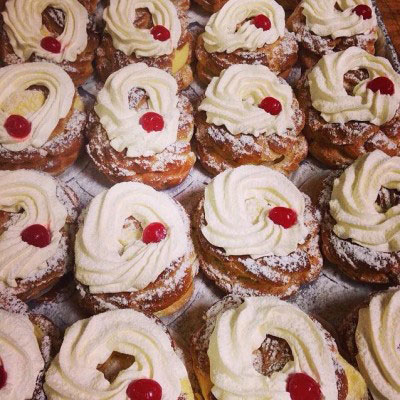 When you live in a state with the highest percentage of Italian Americans in the U.S. (19%), certain cultural traditions permeate the landscape and seep into the awareness of non-Italians even if not paying close attention. Myself being the latter, this year I found myself wondering about the zeppoles (singular is zeppola) I see mentioned and advertised around Easter every year. I knew only two things about them - first that it was some kind of pastry, maybe like a donut, and second that I had no clue how to pronounce it.
In the supposed interest of healthy eating, I could not recollect ever eating one of these presumed Rhode Island traditional foods. I tried to find one last year with half-hearted effort around Easter but the bakery I went into looked at me like I was slightly crazy since it turned out they were a Polish bakery. No zeppoles for me!
Then this year I happened into an Italian bakery right near the statue of Guru and they had them! It looked like a large cream puff. I hesitantly pointed to it and asked to buy it without saying the word out loud (don't forget I have no idea how to pronounce it). I walk out of the bakery feeling like an adventurer pushing off to distant shores, saving it for the next day to learn more about it and actually eat it.
It is a pastry special for St. Joseph's Day that was created back in Italy many hundreds of years ago and eating them on St Joseph's Day (March 19th in the U.S.) is a Rhode Island tradition. Like the cherry on top, I was extra delighted to see that I was eating the zeppola on the actual holiday. What were the chances of that? I fancied myself an honorary Italian-American the same as if I wore green on St. Patrick's Day and felt Irish for a day.
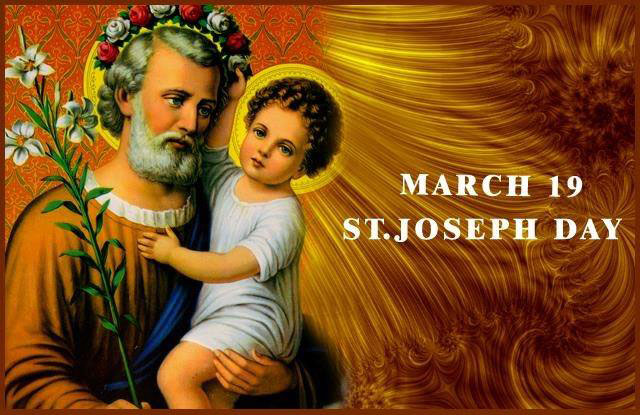
As I partook of this Italian-American Catholic tradition, my thoughts turned to St. Joseph, referred to as the husband of the Virgin Mary and Jesus' legal father. I know little about him but I instantly recalled that there is a tradition of burying a statue of St Joseph upside down in the yard when you are selling your house to ensure a speedy sale/move. Some time back, my parents had done just this when they were trying to sell a house they had built in Michigan and were having trouble selling.
 Coming back to the present moment, I realized that I was in the process of selling a house and buying a condominium and that I never even had a chance to invoke St. Joseph for help because it seemed I used the "Saint of Meant To Be" instead. For reasons that were in some ways obvious and in others perhaps forever a mystery, I was just following through on an inner prompting that I was supposed to sell and move. A series of seeming miracles unfolded along the way, especially when significant hurdles presented themselves at various moments in the process for this 100 year-old house somewhat in need of repair.Me ever the writer, I composed the description for the real estate listing sites and the first day it was on the market and shown by the real estate agent, I had a full price offer to buy the home. St. Joseph was off the hook for this duty. When actions stem from inner guidance and clear indication of God's Will, the only help needed was from the "Saint of Meant To Be." I was relieved to abstain from burying any religious statues under the ground and my invocation of St. Joseph extended no further than the charming tradition of eating zeppoles on St. Joseph's Day.
Related
- Inspiration-Letters main page
Privacy
Last updated: 1 November 2025
Privacy Policy
This privacy policy applies to visitors to www.srichinmoycentre.org. It explains how visitor data is handled and how we comply with applicable data protection laws, including the UK GDPR and, where relevant, the EU GDPR.
1. Contact Form
- The information you provide through our contact form is used solely to respond to your enquiry and—if you request it—to inform you about meditation classes or concerts.
- Submissions are transmitted securely and stored in encrypted form on UK-based servers (subject to UK law).
- Entries older than six months are automatically deleted from our servers and backups.
- The legal basis for this processing is your consent (Article 6(1)(a) GDPR) and our legitimate interest in responding to enquiries (Article 6(1)(f) GDPR).
- If you wish to access, correct, or delete your personal data, please contact us via the contact form.
2. Cookies
- This website itself does not issue any cookies.
- Embedded Vimeo videos may set a small number of cookies when you play them (no personally identifying information). See Vimeo’s cookie policy.
- We do not use any advertising, analytics, or tracking cookies.
3. Cloudflare
We use Cloudflare as a reverse proxy and content delivery network (CDN) to improve speed and security. When you visit our site, Cloudflare may process limited technical data (e.g. IP address, system configuration, and traffic routing data) to deliver its services and protect against malicious activity. All processing is done under legitimate interest to ensure network security and performance. See the Cloudflare Privacy Policy.
4. Akamai Technologies
We also use Akamai Technologies (UK) Limited, The Broadgate Tower, 20 Primrose Street, London EC2A 2EW, United Kingdom, to deliver content efficiently and protect against denial-of-service and similar attacks.
Akamai may temporarily process limited technical data (such as IP address and request headers) to ensure performance and security. Data is retained only for short periods and processed under appropriate safeguards in line with the GDPR, including Standard Contractual Clauses and the EU–US Data Privacy Framework. See the Akamai Privacy Policy.
5. Statistics and Server Logs
- We use Statcounter to understand how visitors use our site (time/date, browser, device type, and referring links).
- Statcounter does not collect the full IP address—only partial information indicating a general city or region. See the Statcounter Privacy Policy.
- Our own web servers record limited access logs for security and error detection. These logs are encrypted and deleted after two months, and all visitor information is also removed from backups.
6. Data Security
- All connections use HTTPS/TLS encryption.
- CMS, plugins, and server software are regularly updated.
- Backups are encrypted and stored in UK/EU data centres.
- Access to personal data is restricted to authorised personnel only.
7. Your Rights
You have the right to:
- Request access to, correction of, or deletion of your personal data;
- Withdraw consent at any time (without affecting prior lawful processing);
- Lodge a complaint with the Information Commissioner’s Office (ICO) if you believe your data has been mishandled: www.ico.org.uk.
To exercise these rights, please contact us.
Compliance
We comply with the UK GDPR and, where applicable, the EU GDPR. We do not sell, rent, or share any personal information with third parties for marketing purposes.
Contact
Tejvan Pettinger
29 Campbell Road
Oxford
OX43PF
+44 1865 437359
Further Information
New Book on Nature and Spirituality
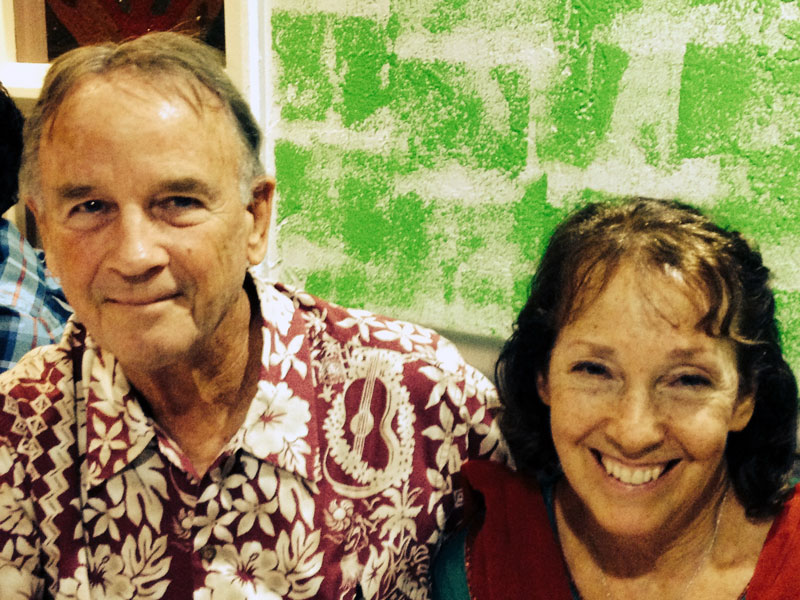
Durjaya Thomas Pliske is a university professor and co-leader of the Sri Chinmoy Centre in Miami with his wife, Drishti. He has been a nature-lover since childhood, and last year he published a book called Light, Truth and Nature which attempts to integrate the spiritual, artistic and scientific perspectives of Nature.
How did you become interested in Nature?
In this life, it started when I was a very young child, probably age 2 or 3, but who knows how far back the roots go. I was lucky to live my early childhood in a rural part of North Carolina surrounded by forests, meadows, farms and gardens. Some of my earliest memories spring from my curiosity about living things: insects, spiders, birds, reptiles, flowers, our pets (dogs and cats) and the farm animals that were our neighbors. I was a very tactile kid. I wanted to catch things, hold them and examine them, not just observe. I learned the hard way about bees, wasps, spiders and some snakes, luckily not from any of the poisonous snakes that are common in the American South. Once when I was five I managed by stealth and stalking to catch a woodpecker by hand in front of my parents and relatives. They couldn’t believe it. “Did you see that? Tommy caught a bird! He just picked it up!”
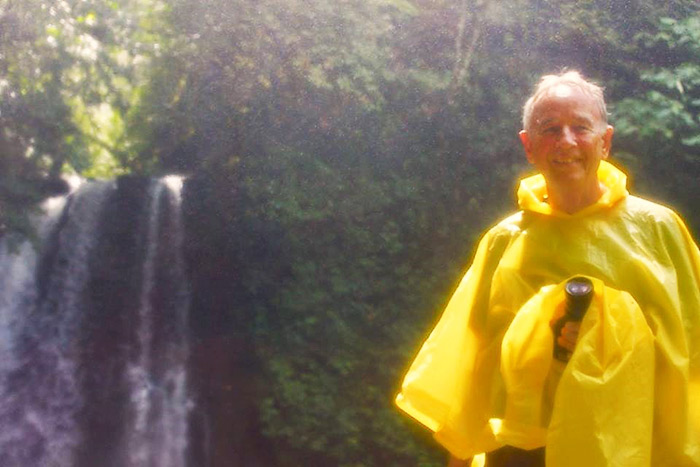
Butterflies were my childhood embodiment of absolute beauty and soul’s thrill - I became a lepidopteran expert while still in elementary school, and began to collect them. Over the years I amassed a huge collection, but when I met my Guru, Sri Chinmoy, in the early 1970s and began to see Nature from a spiritual perspective, I gave up accumulating dead specimens and reverted to my childhood appreciation of their living beauty. At our Miami Sri Chinmoy Centre we have planted butterfly nectar flowers and larval hostplants, so we can always enjoy their presence - more than 30 species as regular visitors.
How did you become interested in spirituality?
My mother was my first spiritual teacher and guide to the inner aspect of Nature. Wherever we lived, she was the gardener and ecosystem manager of the family. She taught me about the sacredness of life and the natural cycles of the environment, with a perspective that was a combination of Christianity and indigenous spirituality. My father was a biological/medical scientist and taught me about the physical side of Nature, but he left the spiritual instruction to my mother. Both parents encouraged my wildlife and ecology interests, even when I started keeping reptiles in my mother’s laundry tubs in the basement. Once when a big water snake escaped down there, I confided first in my father. He said, “Tell your mother you found it and let it go, unless you want to wash your own clothes for the rest of your life.”
My first contact with Eastern spirituality came in 1960 when I bought a book at the Amherst, Massachusetts, town fair for 25 cents: Yoga Psychology by Swami Abhedananda, a disciple of Sri Ramakrishna, a great spiritual master who lived in Kolkata, India in the 19th century. I began reading it and at some point showed it to my college psychology professor - he advised me not to waste my time. Still, I found echoes of my mother’s teachings in Abhedananda’s writings and kept it my library.
In college I learned about Charles Darwin and the doctrine of evolution. This was a major revelation. I gradually came to conceive the universe as a single event unfolding in time and space, each part, including myself, playing a specific role in the cosmic drama. I recall discussing my views of existence with one my fraternity brothers, a philosophy major. He asked me, “What about philosophy and religion?” I replied, “I don’t need them; all I need is Nature and evolution.” He looked at me in exasperation and told me, “You’re a barbarian!” I agreed. There was nothing left to say.
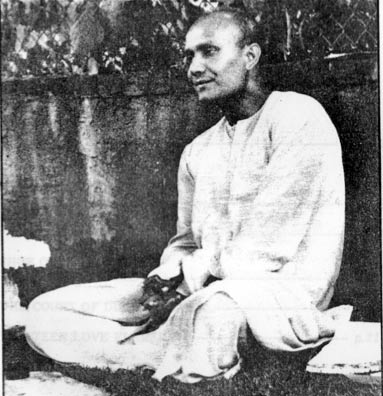
When I became Sri Chinmoy’s disciple in 1973, I discovered that the universe had more to it than the river of changing forms. There was divine consciousness within - Love - something again I had learned from my mother, but Sri Chinmoy’s radiant glance communicated and anchored this Truth - experience deep inside my heart. A few years later I asked a question at a public meditation, “Guru, what is the supreme goal of science?” He replied (my paraphrase), “You are a biologist. You must learn to see life in everything - not just in plants and animals - in everything.” In a few words he had unified Love, Life, Nature, Purpose, Joy and my own existence. I was stunned and grateful, and have spent all the years since aspiring to grow into that wisdom.
Over the years how has your love of Nature and spirituality developed and influenced one another?
For me they are inseparable. It is a matter of identification. Guru showed me, as he is showing all of us at every moment, that using our heart power we have to expand beyond our little I and lay claim to our transcendent cosmic I which is our spiritual goal.
As a teacher and a disciple of Sri Chinmoy, I felt the need to begin moving away from scientific research and toward sharing what I was discovering about myself and about Nature. So I transitioned from a research-focused university professor to a lecturer, where my main duty was teaching. I began looking for ways to introduce spiritual themes into science education. This proved to be easier in the subjects of evolution (continuity of relationships in time) and ecology (continuity in space).
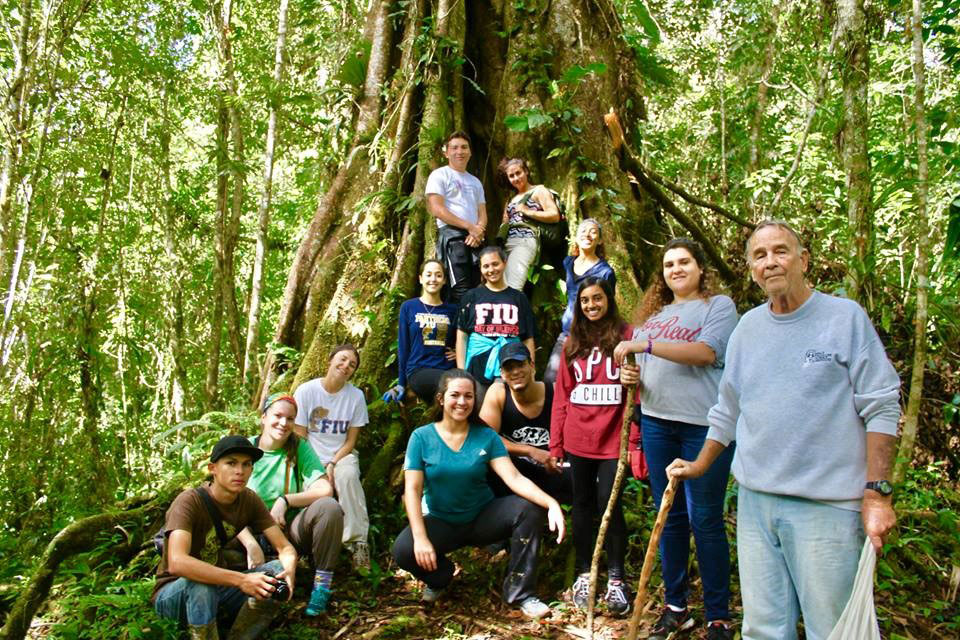
Eventually, an opportunity opened to teach an interdisciplinary course called Deep Ecology where I could present perspectives of Nature other than the in the physical-scientific paradigm. My students read some of Sri Chinmoy’s writings as well as spiritual poetry and philosophy from several other sources, in addition to the more scientifically based writers. University openings for spirituality have come and gone over the years, but as one closes another appears. Currently I am concluding four years of winter studies abroad programs in Costa Rica for small groups of Honors College students and looking forward to teaching a course on environmental sustainability and spirituality in a Religious Studies department - from bugs to the Beyond!
You love Nature, but you are the co-leader of the Sri Chinmoy Centre in Miami, a bustling city. How do you make it work?
Well, for me, Sri Chinmoy’s path isn’t an either-or proposition, it’s a both-and deal, provided the activities are aspiring and progressive. My view of Nature is inclusive - all of Prakriti, the Creation, the Divine Mother. Whatever my spiritual teacher tells me or inspires to do, I try to do to the best of my ability. At our Centre we recycle everything, we compost, use no pesticides and have quite a variety of native plants to support the fragments of native wildlife that still call the city home. We grow organic pineapples, mangoes, coconuts and avocados which we share with our brother and sister disciples and our neighbors as food and prasad. Both of us feel that inner peace and harmony for ourselves needs to be mirrored in lifestyles harmonious with Mother Earth. It is a true blessing to be the caretaker of such a sacred place.
I am so proud and happy that Drishti’s journey has taken her from an expertise in health foods, and nutrition, into therapeutic yoga, and now she is completing studies in Ayurvedic medicine, which is the medical aspect of the Vedic wisdom. With her immersion into Ayurveda, we have become closer partners in our love of Nature’s cosmic wisdom and are trying to use what we have to be instruments of service.
How did Sri Chinmoy encourage your writing?
In 1976, Guru asked two boys in the Centre to write books. He said that both books would be published by Agni Press (the Sri Chinmoy Centre publishing company). One boy wrote on Guru’s music, and he asked me to write about his path and philosophy. The title was Human Nature and its Transformation. He told me (my paraphrase), “Most publishers would give you six months to write a book, but I am giving you six weeks.” Guru had told me many months before that he wanted me to use my writing skills. I’d been on the path for only three years and I recall experiencing great inner joy at the prospect but also being filled with doubt that I could please my teacher with so little spiritual experience under my belt. I told my brothers and sisters in the Centre, “You won’t see much of me for the next six weeks.”
I moved onto the porch of the Centre with a card table, my typewriter (no computers in those days), and a dictionary. The Centre had a complete library of Guru’s writings, so I had everything I needed. I just remember typing and typing and typing for hours each day until the manuscript was done. Guru had put me into a special space where ideas and understanding flowed from within and were more or less immediately transferred to paper. I don’t recall pondering over how to write what came to me, only that I had faith that he would give me whatever capacity I felt that I lacked to accomplish the work he had set me to do. In retrospect I realized the truth of Guru had always told us - that whatever he asked us to do, the capacity would be given. I finished early and sent the manuscript to him. It was duly published by Agni Press and made available to disciples. I have two copies in my library; God alone knows if any others survive anywhere. That was 42 years ago, but the experience and inner force that Guru communicated has energized my writing ever since.
When I finished Guru’s assignment, I still felt the creative power that had been with me for weeks. With this impetus I immediately began to write Jose Mariposa. This is a work of fiction, a sort of short story or allegoric parable. I fancied that it was for children, but it has a serious side and could be roughly analogous to the Narnia stories by C.S. Lewis or Le Petit Prince by St. Exupery. The tale grows out of my many years spent in the tropical forests of South and Central America and also of my acquaintance with indigenous peoples of those regions.
Jose is a simple Costa Rican village boy of a mixed indigenous and Catholic heritage who loves Nature and butterflies in particular. He meets an old indigenous man in the forest above his village who sets him on a quest to experience the ultimate beauty within the natural world. The quest takes years, and spiritual seekers will perhaps find similarities to their own sadhana (spiritual journey).
I submitted the story to Guru in the fall of 1976 shortly after Human Nature and its Transformation was printed. He said that Agni Press would not be able to publish it, but that I should definitely publish it somewhere. Over 40 years later the work is finished, and Drishti wants to illustrate it once she finishes her medical studies. At this point I have no publisher, but some of the girls in the Centre have begun to translate it into Spanish. We’ll have to see what comes next.
Tell us about Light, Truth and Nature, and how you were inspired to write it. What effect do you hope it will have?
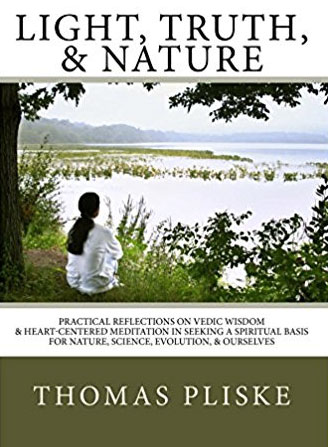
The book is really a series of memoirs, based on my life’s experiences with Nature and as a spiritual aspirant on Sri Chinmoy’s path, but it has the formatting of an academic study, with footnotes and cited references. I recount many personal experiences but try to couch them in a universal frame, and with a logic and breadth that a technically trained person can understand. Since the essays are partly autobiographical, it is hard to place a starting point for the process. One of the sources of necessity for its writing was the feeling of inadequacy and frustration that contemporary science education evokes in attempting to convey the profundity, at a personal level, of our connection with universal Nature. What is missing is the heart-consciousness so integral to Guru’s message, and related to this problem, is the widely accepted idea that Truth is nearly exclusively the domain of science and intellectual enquiry.
I wanted to hold up an even higher standard for Truth, the one that stares us in the face in Nature and in masters such as Sri Chinmoy, Sri Aurobindo and other great souls whose teachings are embodied and founded upon their direct inner experience. As all the great masters have said many times and in many contexts, spirituality doesn’t negate anything; it only adds to everything. Science would be completed and guided by spirituality to become the boon for humanity that is its true destiny as the mind expands.
I’ve met scores of people including trained professionals in different fields all of whom had a deep love and respect for the earth and universal Nature, but the mental-intellectual strictures of scientific analysis gave very little room to express or even tolerate our pervasive appreciation of Nature’s poetic beauty, mystery, scope and consciousness.
On the other hand, in teaching Deep Ecology I had to reread a great deal of Guru’s writings as well as a variety of other spiritual masters, philosophy, poetry, spiritual fiction and the experiences of indigenous people. I saw it was possible to integrate spiritual, artistic and scientific perspectives of Nature and that my students were responding enthusiastically. I hoped to inspire a wider audience if all the inner and outer pieces of the mystery, heart and mind, could be assembled in a way that addressed both the searching mind and the illumining heart.
As the last version of the Deep Ecology course closed in 2013, I felt a surge of inspiration-power to write a book that would bridge the abyss between the two disparate systems of thought and experience. I started making notes and outlines and drafted some partial chapters, but was accumulating a box of fragments rather than any kind of synthesis.
At this point, I asked Guru inwardly whether I should persevere with the project, and every time I did so I got blaze of affirmation. In 2015 many of the fragments began to cohere and I began to see a vision of what the completed book should contain and how it might be organized. I hadn’t a clue about how or where to publish it, but felt it would have to be an outside publisher to give the book credibility with non-disciple readers. I discussed the project with one of my sister disciples in our Centre, a philosophy professor, and she connected me to a mutual friend, one who had actually been a guest lecturer in Deep Ecology some 30 years previously and who was the editor-manager of a small publishing company that specialized in works connecting spirituality and science. Once I explained the premise of the book, he accepted it sight unseen based on the mutual respect we shared.
Throughout 2016 and the first half of 2017 I worked at writing in whatever moments became available. The more I worked, the more quickly and things fell into place. I hope that at some point it will serve as a springboard from which a Nature lover can enter into a deeper identification with glowing, dynamic and stupendous Creation in which we all partake and which is our birthright.
Related
- Light, Truth and Nature - by Thomas Pliske at Amazon
Oneness-Dream tour the Czech Republic
Recently Oneness-Dream, an international group of male acapella singers, visited the Czech Republic where they performed the songs of Sri Chinmoy at various sacred sites. They have been touring different countries with acapella performances since 2011, allowing the purity, simplicity and soulfulness of Sri Chinmoy's songs to touch the heart of the audience.
(Sample song from a concert in Croatia, 2015)
The singers came from England, Scotland, Australia, Germany, Serbia, Holland, France and of course the Czech Republic.
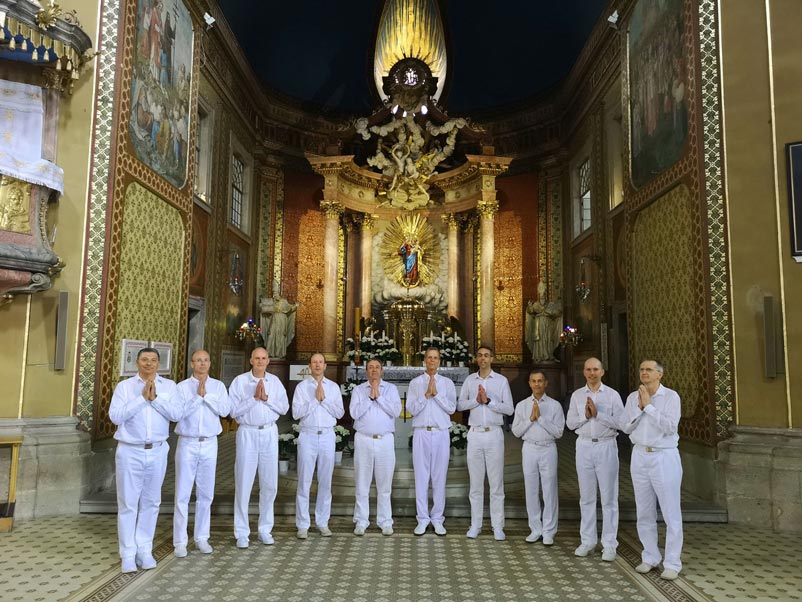
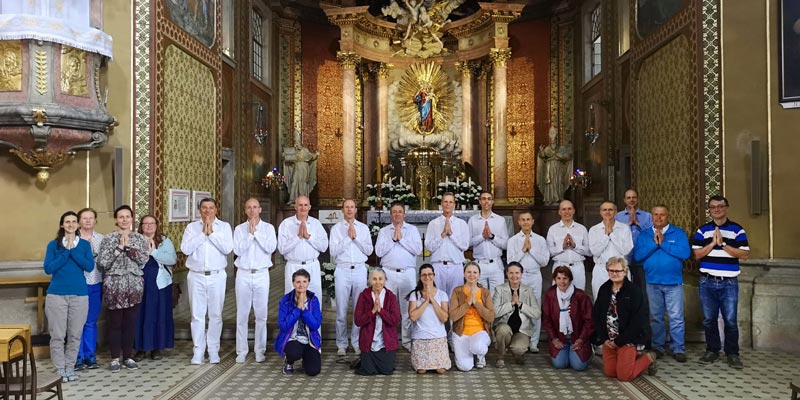
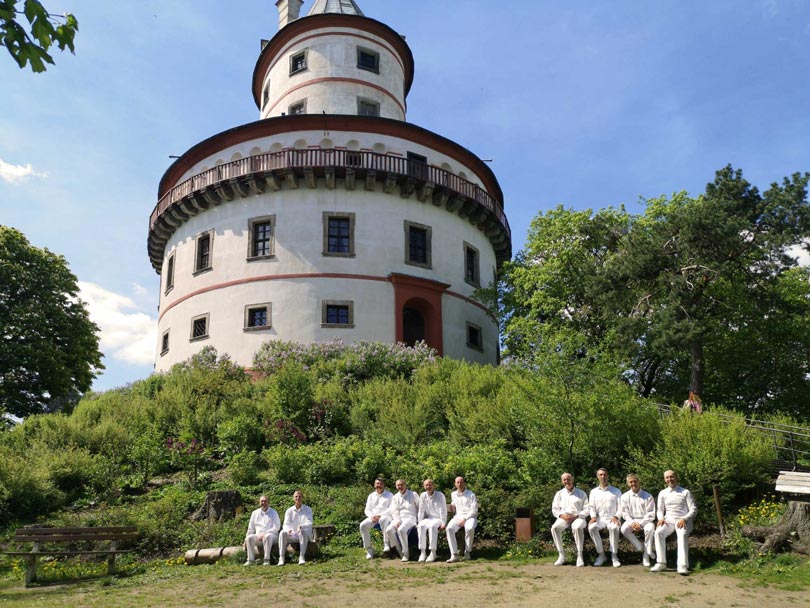
Oneness-Dream were founded in 2011 and have recorded four albums. The singers are drawn from different Sri Chinmoy Centres around the world.
Sri Chinmoy composed over 22,000 songs - expressing a range of spiritual emotions and devotional sentiments.
“Soulful music is the music that wants to eventually transform our consciousness. It carries us into the Universal Consciousness and makes us feel that we are in tune with the highest, with the deepest, with the farthest.”
– Sri Chinmoy1
External links
- Oneness-Dream at Radio Sri Chinmoy
Photos: Kedar
- 1. Sri Chinmoy, God the Supreme Musician, Sri Chinmoy Lighthouse, 1974
Peace Run video from Nepal
Recently, the Sri Chinmoy Oneness-Home Peace Run visited Nepal. This video gives an insight into how the Peace Run touches many people, who take the opportunity to share in the spirit of the Run. It also gives a glimpse into the natural beauty and rich cultural heritage of Nepal.
During the week long visit, the Peace Run visited several schools, with children taking part in ceremonies focused on the message of peace. The Peace Run was also warmly welcomed by a variety of dignitaries and local people who offered their prayers and good-wishes for peace.
"May the flames of peace-torch
Kindle and awaken
Each and every world-citizen."
Sri Chinmoy 1
The Peace Run is co-ordinated by an international team of runners from around the world.
Related
- 1. Sri Chinmoy, A love-bathed heart, Agni Press, 1993
Sri Chinmoy Ten and Six Day Race 2018
Recently, the 2018 edition of the Sri Chinmoy Ten and Six Day race finished in Flushing Meadows, New York. For this testing multiday event, there were over 80 entrants who braved the cold, wind and rain in an unusually cold edition. The winner of the men's Ten Day Race was Ashprihanal Aalto from Finland, an accomplished multiday runner and World Record holder for 3,100 miles. Despite health issues, he managed a daily average of 82.6 miles. In the women's Ten Day event Ilvaka Nemcova from the Czech Republic completed 621 miles.

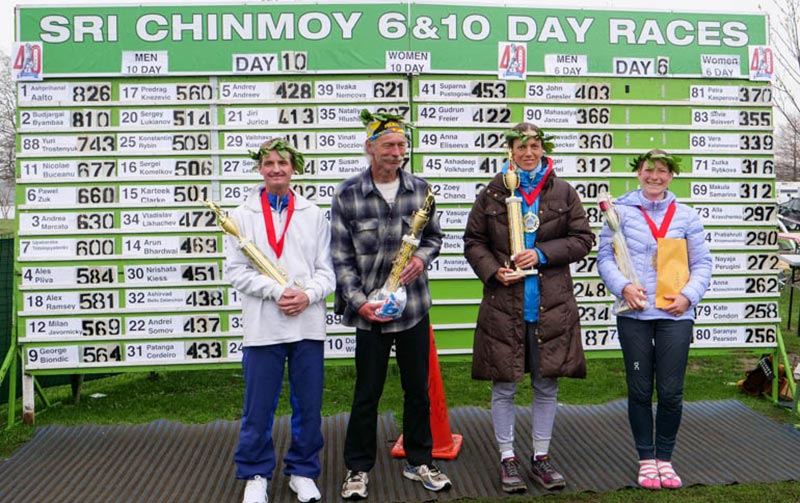
Ten Day Race
- Men: Ashprihanal Aalto - 826 miles
- Women Ilvaka Nemcova - 621 miles
Six Day Race
- Men - John Geesler (USA) - 403 miles
- Women - Petra Kasperova, Czech Republic - 370 miles
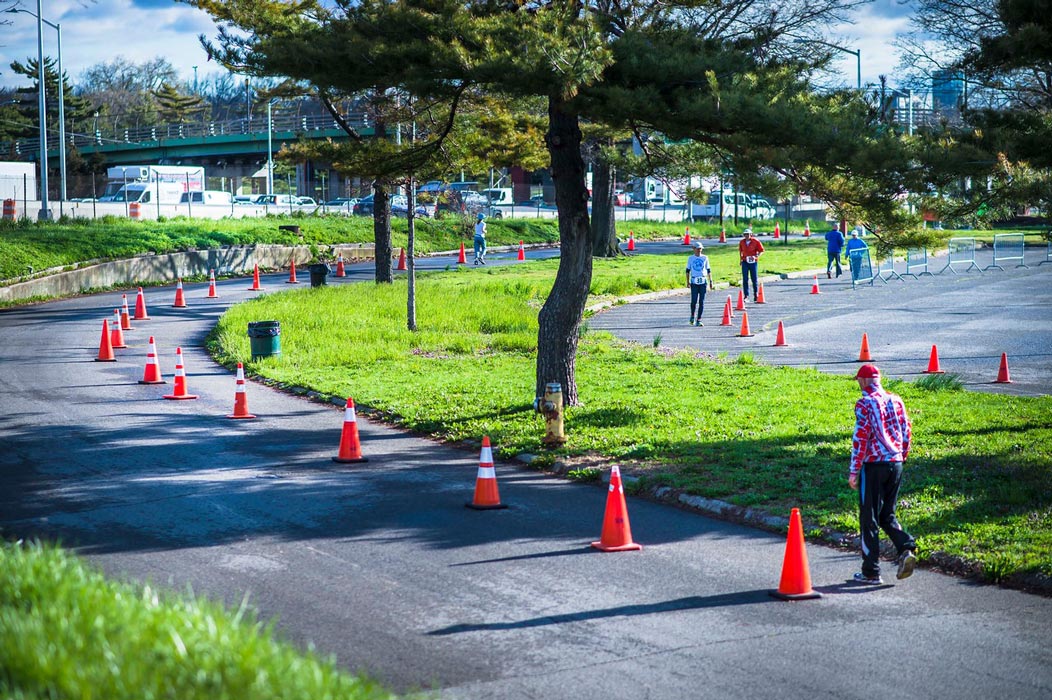
The Sri Chinmoy Marathon Team have been organising multiday events in Flushing Meadows, New York since 1985 and the inaugural 1,000 mile race. Over the years this has evolved into the present format of a six and ten-day race. The race was founded by Sri Chinmoy who saw running as an opportunity to enable physical fitness but also spiritual self-transcendence. To put on the race, a team of volunteers work around the clock to set up the race, count runners, cook food and provide medical support.

A multi-day event requires the runner to dig deep and use all aspects of his being to overcome the physical and mental challenges of the event.
“We compete not for the sake of defeating others, but in order to bring forward our own capacity. Our best capacity comes forward only when there are other people around us. They inspire us to bring forward our utmost capacity, and we inspire them to bring forward their utmost capacity”
– Sri Chinmoy 1
Other photos of the race

Petra Kasperova - 6 day winner

Asprihanal Aalto
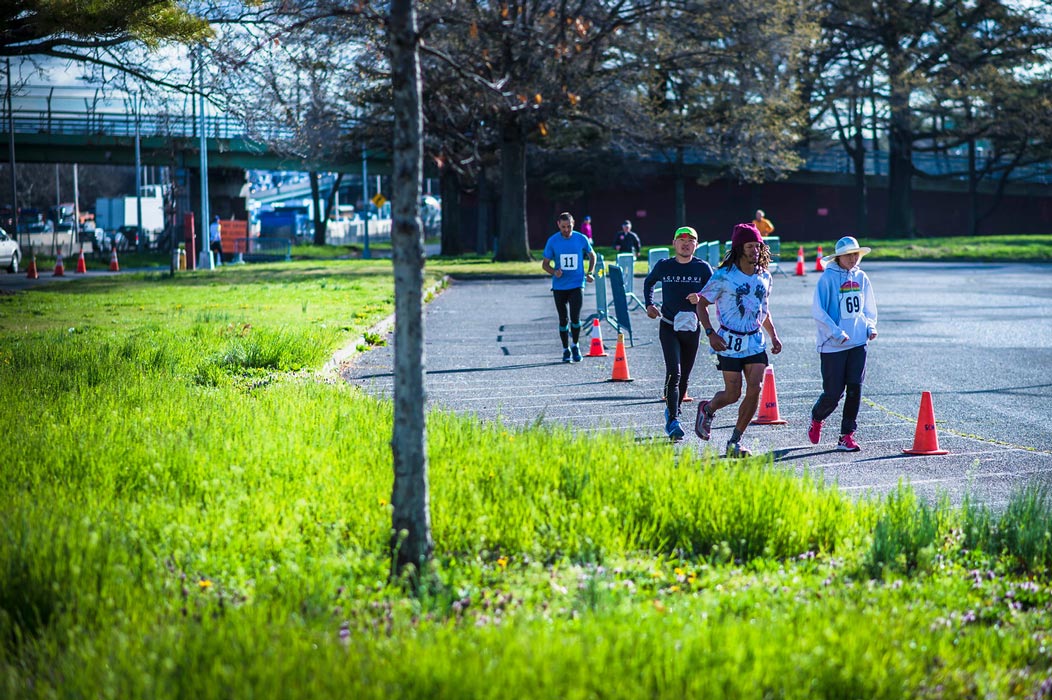
Yuri Trostenyuk - a former 10-day and 3100 mile Race winner
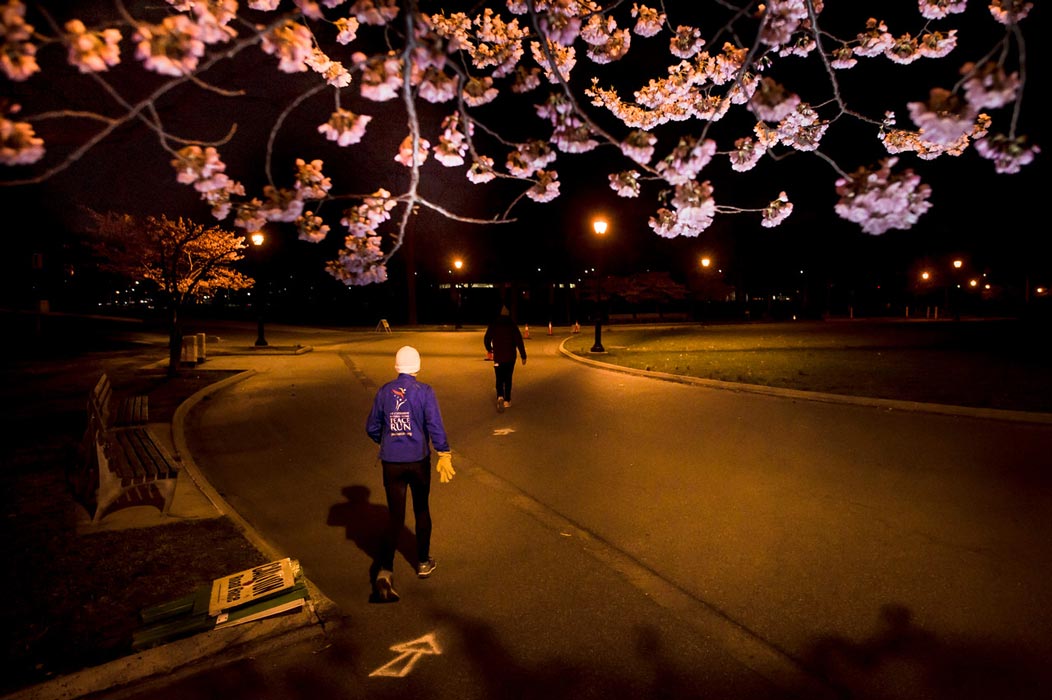
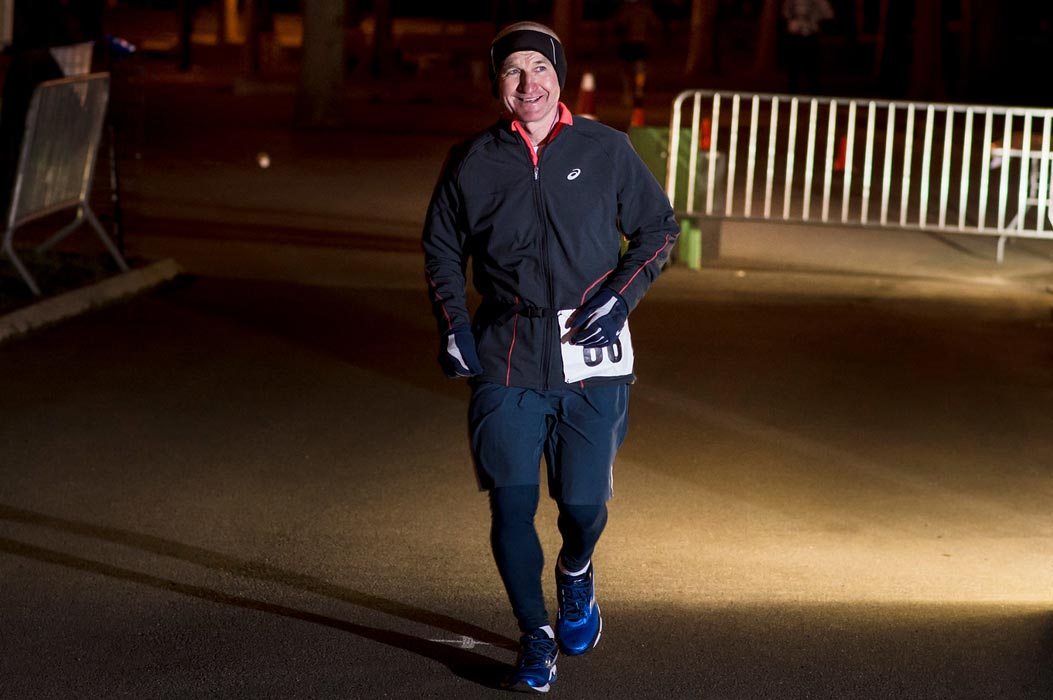
The race goes on through the night - the clock runs 24 hours a day.
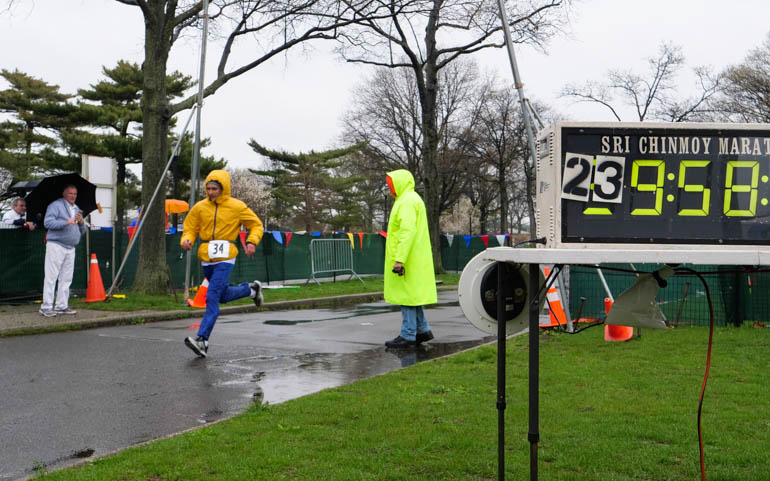
The final runner to cross the line
Related
- Six and Ten Day Race at Sri Chinmoy Races
Photographers
- Jowan (photo album)
- Utpal (Perfection Journey)
- Prabhakar (photo album)
- 1. Sri Chinmoy, The body: humanity's fortress, Agni Press, 1974
If I were a book, what would my title be? - a creative project
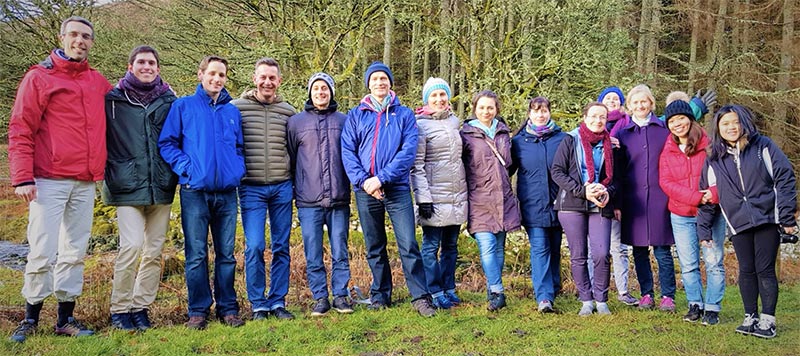
Sri Chinmoy asked his students to meet together frequently for meditation, spiritual activities and fun that he called Joy-Days. Very often, these happen over a weekend when people from all the Sri Chinmoy Centres in a country, or even in different countries, can come together.
On one such recent weekend in Co Wicklow, Ireland, students of Sri Chinmoy from Ireland and England came together. As part of the weekend, different members engaged in a spontaneous creativity project given the simple question 'If I were a book, what would my title be?'. Ambarish from the Dublin Centre collected all of these questions and made some charming videos, which you can see below:
Whatever we do in life — whether we are praying, talking to our friends or participating in sports — we are trying to receive joy at every moment. But joy we can have only when we have a peaceful life. We are all longing for joy, and joy abides only in peace. At every moment we are given the opportunity to feel peace in the depths of our heart on the strength of our prayer-life and our meditation-life.
Sri Chinmoy 1
- 1. Sri Chinmoy, Aspiration-body, illumination-soul, part 2, Agni Press, 1993
- ‹ previous
- 81 of 337
- next ›

Except where explicitly stated otherwise, the contents of this site are licensed under a Creative Commons Attribution-NonCommercial-NoDerivs 3.0 Unported License. read more »
SriChinmoyCentre.org is a Vasudeva Server project.